
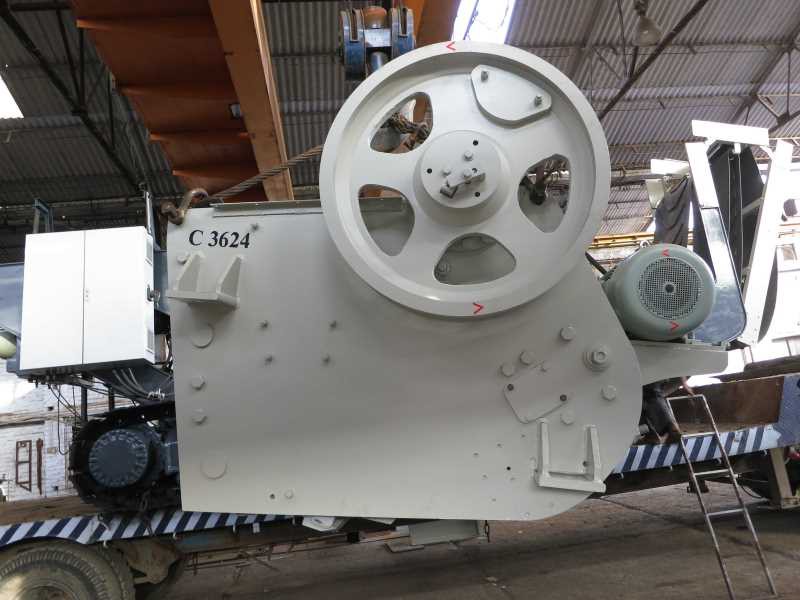
Feed opening, closed side setting, capacity and the rock you crush: the five questions to answer before you buy a primary jaw crusher.
The jaw crusher is the first machine your rock meets, so it sets the pace for the whole plant. Choosing the wrong size either starves the downstream crushers or turns the jaw into a permanent bottleneck. These are the questions we ask every customer before recommending a Conmix Jaw Crusher.
1. What is the largest boulder you will feed?
As a rule of thumb, the largest feed lump should be no more than about 80 to 85% of the jaw's feed opening (gape). If your excavator or blast regularly produces 700 mm boulders, a crusher with a 900 mm opening gives the rock room to enter the crushing chamber without bridging.
2. How many tonnes per hour do you really need?
Work backwards from the final products. Add the hours your plant will actually run, the expected downtime and seasonal peaks. A primary crusher sized for the average day will hold you back on the busy ones; a little reserve capacity is cheaper than a second shift.
3. What is the closed side setting (CSS)?
The closed side setting is the narrowest gap between the fixed and moving jaw. It controls the product size and the capacity: a tighter setting gives a finer product but lower throughput. Most primary jaws run at a CSS that suits the secondary cone or VSI that follows them.
4. How hard and abrasive is your rock?
- Basalt, granite and trap rock are hard and abrasive: choose heavy cast steel components and manganese jaw plates, and plan for regular plate rotation.
- Limestone and softer rock allow higher capacity at the same setting and lower wear cost per tonne.
- Construction and demolition waste needs a robust feeder with a grizzly to remove fines and a way to separate rebar.
5. Stationary, semi-mobile or track mounted?
If the plant will stay at one quarry for years, a stationary crushing plant gives the lowest cost per tonne. For contract crushing and road projects that move every few months, a semi mobile plant or a track mounted jaw crusher saves weeks of civil work at every move.
Quick checklist
| Question | Why it matters |
| Maximum feed size | Decides the feed opening |
| Required capacity (TPH) | Decides the crusher size and drive power |
| Product size from the primary | Decides the closed side setting |
| Rock type | Decides wear parts and running cost |
| How often the plant moves | Decides stationary, semi-mobile or track mounted |
Talk to our engineers
Every site is different. Share your material, feed size, required output and site conditions through our sales inquiry form or call us, and the Shree Conmix Engineers team in Ahmedabad will recommend the right equipment.